
Flowers
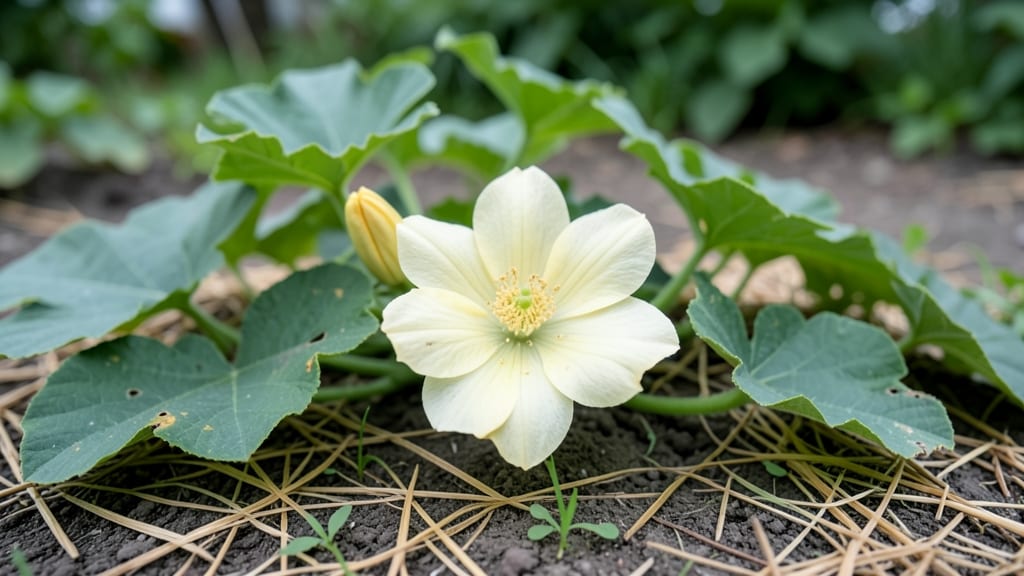
Male cantaloupe flowers appear as small, single-stemmed buds with no ovary at the base, lacking the swollen fruit base of female blooms. They play a key role in pollination, releasing pollen to fertilize female flowers for fruit development. Look for slender stems and no swelling at the flower’s base to distinguish them from female flowers.
Male cantaloupe flowers are the plant's pollen producers, designed solely to fertilize female blooms that develop into fruit. 🌼 Unlike female flowers, they lack the bulbous ovary at the base, which is where cantaloupe fruit begins to form.
These male blooms typically appear first in the growing season, giving them a head start in supporting fruit development later on. If you're growing cantaloupes, identifying these flowers early helps you understand when to expect female blooms—and potential fruit—to emerge.
Understanding their role also explains why some gardeners hand-pollinate their plants. When bees are scarce or weather conditions aren't ideal, manually transferring pollen from male to female flowers ensures better fruit set.
I've found that using a small paintbrush in the morning—when flowers are freshest—works best for this process. The key is patience: female flowers won't develop without successful pollination from their male counterparts.
💡 In This Article
- How Male Cantaloupe Flowers Differ From Females
- Best Pollination Methods for Cantaloupe Fruit Set
How male cantaloupe flowers differ from females
Here's what's actually happening at the botanical level: male cantaloupe flowers develop from androecium structures containing 4-5 stamens (pollen-producing organs) arranged in a tight cluster around a slender stem.
These stamens typically measure 3-5 millimeters long, with bright yellow anthers that split open to release pollen grains measuring 20-40 microns in diameter. The entire flower structure sits on a thin, hairless stem about 1-2 centimeters long, creating that signature delicate appearance.
The key difference lies in their reproductive anatomy: male flowers lack the gynoecium (female reproductive organ) entirely. Instead of developing an ovary at the base, they remain hollow-stemmed, while female flowers develop a swollen ovary (future fruit) measuring 5-10 millimeters in diameter within 24-48 hours of opening.
This ovary contains 2-4 ovules that will develop into seeds after successful pollination. The petals themselves are also slightly different—male flowers have 5-6 petals measuring 1.5-2.5 centimeters across, while female petals tend to be 10-20% larger to accommodate the developing fruit.
Temperature plays a crucial role in their development: male flowers tend to emerge first when soil temperatures reach 65-70°F, while female flowers appear 7-10 days later when daytime temperatures stabilize above 75°F. This sequential blooming ensures pollen availability when female flowers are receptive.
What most people don't realize is that humidity levels also affect flower sex expression—dry conditions (below 50% humidity) can increase male flower production by up to 30%, while high humidity favors female flowers.
This environmental sensitivity explains why gardeners in arid regions sometimes struggle with poor fruit set despite abundant male blooms.
Visually distinguishing them requires examining three key areas: the stem base, flower structure, and growth timing. Male flowers have no swelling at the stem base, while female flowers develop a small bulbous bump within hours of opening.
The stamens in male flowers are also more prominent—they protrude noticeably from the petals, while female flowers have shorter stamens that appear almost hidden behind the petals.
Another telltale sign is the scent: male flowers emit a subtle sweet aroma to attract pollinators, while female flowers have a milder, less noticeable fragrance since their primary role is to receive pollen rather than advertise for it.
What makes this particularly interesting is how these differences translate to fruit production. Each female flower can develop into a single cantaloupe, but requires pollen from at least 2-3 male flowers for optimal fertilization.
This is why gardeners often see more male flowers than female—the plant prioritizes pollen production to ensure successful fruit development.
In commercial operations, growers sometimes use plant growth regulators like ethephon to increase female flower production by up to 40%, but this requires careful monitoring to avoid stunted growth.
The timing of these differences matters too: male flowers typically open 1-2 hours before dawn, while female flowers open 2-3 hours later. This staggered opening maximizes pollination efficiency, as bees and other pollinators are most active during mid-morning.
If you're hand-pollinating, timing matters—collecting pollen from male flowers in the morning and transferring it to female flowers by 10 AM gives the best results. The pollen remains viable for 4-6 hours after release, so working within this window is critical for successful fertilization.
One final insight: the ratio of male to female flowers isn't fixed—it varies by cultivar and growing conditions. Some varieties like 'Athena' produce 60% male flowers, while others like 'Hale's Best' may have a more balanced 1:1 ratio.
Understanding these variations helps explain why some cantaloupe plants seem more productive than others, even under identical growing conditions. 🌟